
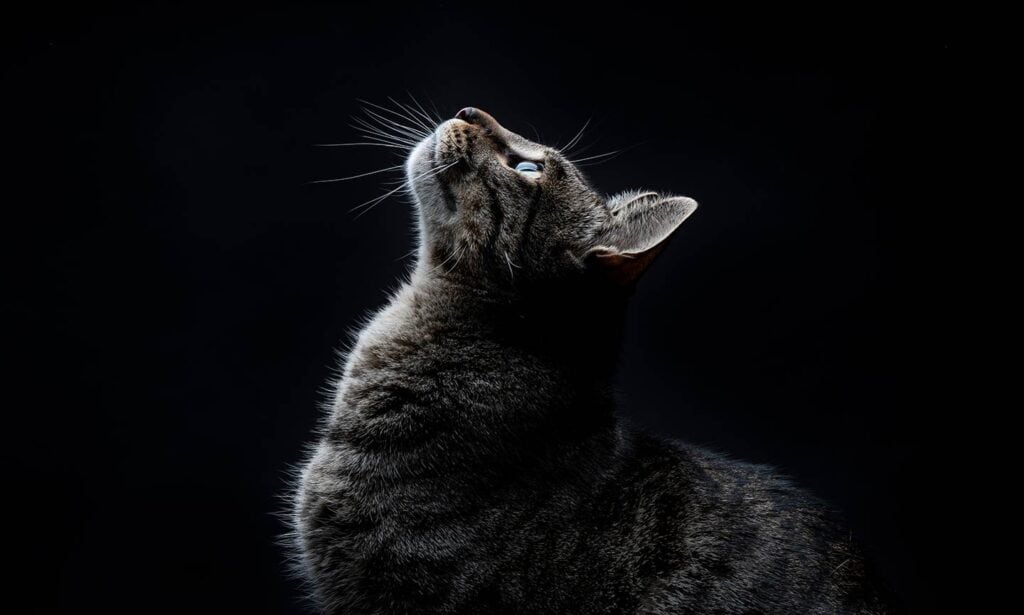
In the evening, my cat will occasionally turn her gaze upward and stare at something invisible to me. She will follow this entity with her eyes as it moves, apparently, along the wall just below the ceiling. She does not seem disturbed by what she perceives, just keenly interested. After a moment or two, she will blink and look away, settle back into my lap. Whether the object of her attention disappears or she simply grows bored with it, is anyone’s guess. “It’s their eyes,” a friend says. “They absorb light and then reflect it—like headlights on a road sign. Cats see a whole world we don’t.” I have no idea what my cat sees; I only know that sometimes, in my living room at night, we are not alone.
Recently I met a childhood grief counsellor. She works with preschoolers, children brought to her by over-cautious parents who do not understand that some boys and girls really do see ghosts, only they call them Grammy or Grandpa or Uncle Fred, whatever the case may be, and while the parents are alarmed by these sightings, the children are not. Too young to fear anything but falling or loud noises, they are typically comforted by their visions. Grammy has come to visit, this is all they know. Science has not yet entered their lives. Their world is made of magic, and magic allows for everything. As they get older and start to reason, they lose this perceptual power. By the age of seven it’s all but gone, along with those “imaginary friends” children often describe.
They remember past lives too, the counsellor went on, though only a few are highly verbal and can articulate these memories. One little boy, at two years old, recalled dying in a plane crash. He described the fiery plane and how he couldn’t get out of it, offering so many specifics that researchers were able to “solve” his case by tracing the details back to a pilot who did indeed crash in the ocean during the Battle of Iwo Jima.
What she has learned from children, the counsellor told me, makes her think twice about certain conditions–savant syndrome, child prodigies, even those phantoms the dying speak of. Science is a wonderful thing, she said, and sometimes it’s no help at all.

 Jean Ryan
Thank you for that. It’s such a needed antidote for me right now. We live in world of adults who long ago forgot where we came from.
Every life is a story,
and each of us is the storyteller.
Mark McNease
Author, Publisher, Instructor
Mark McNease.comhttps://markmcnease.com/
YourWritePath.comhttps://yourwritepath.com/
Certified Guided Autobiography Instructor
Visit my storefront for books and more!https://payhip.com/mademarkpublishing
Thank you. Life overflows with mystery. I try to stay attentive, to summon that vanishing wonder.
As always, Jean writes in a way that makes me expand my understanding of human nature. Thank you for this thoughtful piece.
Thank you, Taya. This marvelous world is why I’ve never had much interest in science fiction.
Life is a mystery. Sometimes I find myself staring at an object for no apparent reason, a moment of silence, and my brain can stand still, some call it day-dreaming, I call it self preservation. Well written my friend, and thank you for sharing. ❤
Thank you, Jinxie. We all need moments of wonder, now perhaps more ever.
Thank you for a beautiful respite from the madness that’s going on all around us.
What would we do without wonder? There is so much mystery around us; it’s thrilling to be reminded of this. Thank you for stopping by. 💕