Jean Ryan, a native Vermonter, lives in Lillian, Alabama. Her stories and essays have appeared in a variety of journals and anthologies. She has also published a novel, LOST SISTER. Her short story collections, SURVIVAL SKILLS and LOVERS AND LONERS, are available online. STRANGE COMPANY, a collection of short nature essays, is available in paperback as well as digital and audio editions.
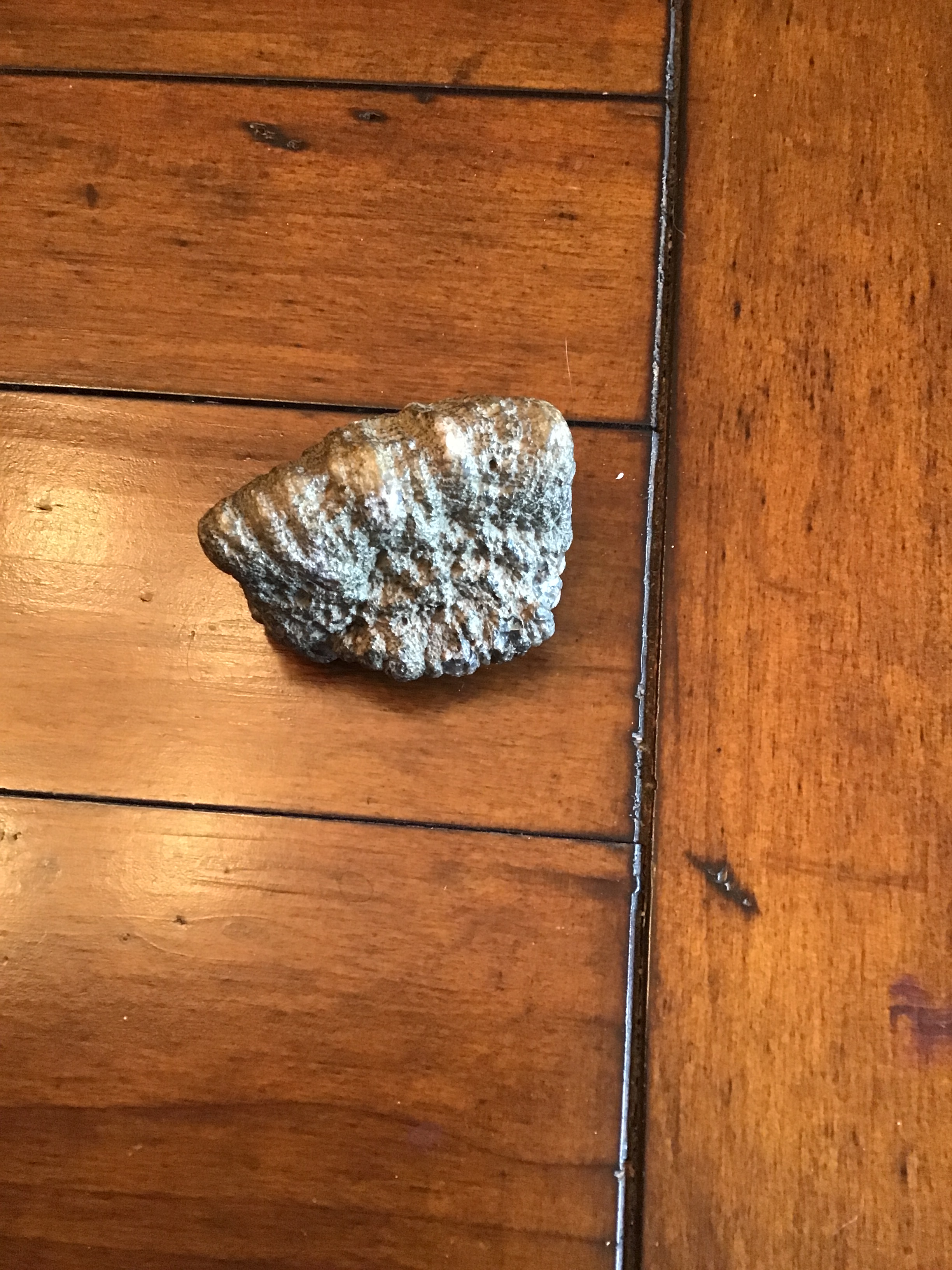
When I am not writing or painting, you can often find me hunting for fossils. I found this specimen in Northern California. 3″ long, 2″ wide and high, it is extremely dense and partially agatized. Several fossil enthusiasts have weighed in but it remains unidentified; it may not be a fossil at all. I would greatly appreciate anyone’s guesses.
How we view time can be a source of comfort or pain. Many people, particularly eastern cultures, adhere to the belief that we live any number of lives: time is seen as cyclical and forgiving. Westerners tend to see time as linear, something we use up, something we never have enough of.
Whatever our beliefs, we all know that the lives we are living now will one day end. This knowledge is the ultimate spoiler, the price we pay for having a neocortex. Other animals are not saddled with this awareness—at least I assume, I hope, they are not.
In 1777 the British explorer Captain Cook gave a newly hatched tortoise to a royal family in Polynesia, who kept the creature as a pet until it died of natural causes 188 years later. That turtle pulled its heavy self across the ground, presumably the same well-worn ground, for 68,620 days. Was it weary by then? Bored? Might it have opted for a life half as long?
On the other end of the spectrum is the mayfly, a creature whose adult life amounts to less than a day; in some species, just a few minutes. The larval versions, naiads, can live up to a year, during which they hide in aquatic debris and progress through several stages—instars—before growing a pair of wings and becoming immature adults. The winged juveniles last no longer than the final version and are not sexually viable until a few hours later, when they emerge from their last molt with features unique in the insect world, paired genitals: two penises for the males and two gonopores for the females. They do not feed: their mouths are useless and their digestive tracks are filled with air. This day, their first and last on earth, all they do is mate—little wonder our creator doubled up on their genitalia.
Like locusts, mayflies “hatch” in stupendous numbers, trillions at a time. The males begin swarming over a river and the females fly into this mass. With specialized legs, the male grab a female and copulation takes place in mid-air, after which the female falls to the water’s surface and lays her eggs before dying. The spent females cover the water, providing a feast for the fish below. The males fly off to die on land, a boon to local birds.
Even the waiting wildlife cannot keep pace with these mayfly windfalls, and in some municipalities snow plows are deployed to clear away the mountains of corpses. While Americans consider mayflies a nuisance, tribes in Africa make nutritious patties out of them.
It would seem that a mayfly’s fleeting life amounts to nothing more than sustenance for larger creatures. Mayflies, all 2500 species of them, are designed as sacrifices, put here for the greater good. Twenty-four hours is all the time they are given and all the time they need.
The ancient Greeks had a saying:
“There is not a short life or a long life. There is only the life that you have, and the life you have is the life you are given, the life you work with. It has its own shape, describes its own arc, and is perfect.”
For nine to ten months each year the male bowerbirds of New Guinea work on their bowers. The style of the bower depends on the species. “Maypole” builders place hundreds of sticks around a sapling, winding up with a great mushroom-shaped structure. Other birds create “avenue” bowers, vertical rows of twigs imbedded in the earth between a narrow passageway. After construction, some of the more fastidious males will use their sharp beaks to paint the inside walls with plant juices. Finally, the birds begin to decorate, using whatever strikes their fancy: hunks of moss, red berries, silver snail shells, golden leaves, flowers, feathers, stones. Their whimsy extends even to manmade items: discarded batteries, toothbrushes, coins, nails, rifle shells, pieces of glass, strips of cellophane. Color is important. Some bowerbirds favor blue tones, while others prefer white or orange. Work is never quite finished; the birds spend weeks rearranging their treasures and adding to the plunder―stealing from one another is a common practice.
And the purpose of these sylvan palaces? It’s the same old story: seduction. Year after year these indefatigable birds give everything they’ve got for the chance to spend a few glorious seconds on the back of a female. Rich in suitors, the female bowerbird flies from one endeavor to another, assessing and rejecting, till she finally lands on the threshold of the bower she likes best. Sometimes she obliges the waiting male right away; other times she requires coaxing and the frenzied male will offer her gifts, a blue paperclip, an orange leaf. If these fail him, he will strut back and forth, extending his wings and chattering loudly so that she can see what a superb specimen he is. Many females end up selecting the same male and returning to him the next year, paring the chances for the other males whose efforts are nonetheless worthy.
So what becomes of all the bowers that don’t make the cut? Do they fall into disrepair, victims of time and weather? Or do the builders themselves do the dismantling, starting from scratch each fall, their bird brains brimming with fresh ideas?
I have no trouble believing that the initial impulse to build a bower is a reproductive imperative. At some point, though―perhaps after the forty-eighth golden leaf, the first dozen blue parrot feathers—I think this primal urge is forgotten and what drives the male after that is his own enthusiasm, craft turned to ecstasy. For what difference would it make to the no-nonsense, time-constrained female that there are thirteen parrot feathers instead of twelve, or that the interior, which she may not even bother to inspect, is freshly painted?
Only to the builder does every leaf and feather matter; each year, from fall through spring, nothing matters more. That his work may be in vain is something he is not prepared to ponder.
People, on the other hand, expect reward. The formulas we are taught—hard work equals success, healthy living ensures longevity, good deeds bring good luck―these ideas die hard and not without bitterness. Our house is blown away; the tumor is malignant; the dog we adopted gets hit by a car. “It’s not fair,” we cry; moreover it doesn’t make sense. Why would God allow such things? Why are we sharing our home with polio and salmonella and brown recluse spiders? Where is the virtue in poisonous toadstools and powdery mildew? Indeed, our madcap inventor seems to have as much interest in the growth of a fungus as he does a fetus.
Whatever your religious views, one thing is certain: a long time ago this ball got rolling and a force we can’t fathom gave it the nudge. From that point on, life never looked back.
Consider the extravagance of species on this planet: 140 kinds of sparrows, and every one of them changing, each generation bringing better beaks, designer tails, new come-hither stripes. So many versions of a small brown bird, all of them vying for a little more time. Why not, say, a dozen species? Wouldn’t that be a sufficient sparrow allotment? Why is the earth burdening itself with this colossal balancing act?
Watching children play or dolphins leap or eagles soar, it’s easy to conclude that life is fun, that we are put here to enjoy ourselves. Take male lions, which spend their days on grassy plains, dozing in the sun, dining on warm fresh prey, thanks to the prowess of their harems. Then take a look at male emperor penguins, which spend long winters on open ice, huddled together for warmth, risking starvation, a single precious egg balanced on their frigid feet. A tortoise trudges along for well over a century; a mayfly gets less than a day. One bird scores a mate with just a couple songs, while another must build a palace. Not one of these creatures knows the difference. “Why” is a question we might all do without.
To be born is to have worth. Lucky or not, lovely or not, everything on this busy blue orb gets a fighting chance to do its best. Rust and roses. Slugs and swans. Lyme ticks and ladybugs.
Does it feel good to be a ladybug? We can’t say. All we can witness is the effort: one tiny being earning its life.
It hurts to be alive, too much and too often for pleasure to be the point; much of the time we manage without it. Now and again we are taken by surprise. In the oddest moments—spreading mulch, washing a plate, buttoning a child’s coat—we are suddenly, inexplicably, happy. For the bowerbird, whose life amounts to little more than labor, the joy is built right in.
Two-toed sloth hanging from a tree in the jungle in Costa Rica.
Do animals think? Countless experiments have been undertaken to answer this question and the consensus is: Yes, they do.
I guess I’ve always considered this answer fairly obvious. How would creatures survive if they couldn’t evaluate situations and make appropriate decisions? Lionesses form collective hunts. Crows drop their walnuts into the path of vehicles. Beavers adjust the logs in their dams to control water levels. Plovers fake a broken wing to lure predators away from their nests. God knows what chimps and parrots are capable of.
When they are not trying to acquire food or protect their young or get attention, what do animals think about? When a lion has finished his dinner and is gazing out on the African plain, what is going on in his feline mind?
The sloth. Now there’s an animal with plenty of time to mull things over. Looking at a photo of a sloth—the big eyes, the gently smiling mouth—I am certain that something astonishing is going on in that short, flat head.
Sloths spend their lives hanging upside down from tree branches. In this pose, they eat, sleep, mate, bear young and die; even after death a sloth may hang from a branch for days, as if the divide between death and its sedentary life does not much matter. The world’s slowest mammal—an average clip is six feet a minute— sloths move only when necessary so as not to tax their minimal musculature. On the ground they are awkward and vulnerable, long polished claws serving as their only defense. For this reason, they stay in the trees, descending just once a week to urinate and defecate, digging a hole and covering it up afterward. While slowness might be considered a detriment to survival, this trait is actually an advantage for the sloth, whose lack of motion draws no attention. Another advantage of a slow pace is the chance it gives other life forms to take hold: algae blooms freely on sloths, serving as perfect jungle camouflage, as well as a handy food source.
Nocturnal creatures, sloths forage on their trees from dusk to dawn, methodically eating the fruit, leaves and bark. This roughage is then effortlessly digested, albeit slowly, with the help of multi-compartmentalized stomachs that comprise two-thirds of the animals’ body-weight.
Once a year the female lets out a few loud shrieks, which the male dutifully answers, and after great time and effort, they manage to arrive on the same branch. The mating itself occurs over a period of several minutes, and in what seems to be a tender fashion—sloths are the only mammals other than bonobo apes and humans that mate face-to-face. The baby sloth appears six months later and spends much of its first year clinging its mother.
Research shows that sloths spend about ten hours a day sleeping. In the hours the animal is awake but inactive, it hangs from its limb and regards the jungle canopy, moving its flexible neck in increments, blinking now and then. Hidden among the leaves, making no sound or movement, these mute little beasts seem to want just one thing: to be undiscovered.
The two main emotions in life are love and fear, and certainly there is ample evidence that animals feel both. I imagine that when the shadow of a raptor passes overhead, a sloth cringes in fear. What about the lesser emotions, the ones that don’t serve us—like worry? Does a sloth, with all that time he has, worry about eagles and jaguars? Or does he have more productive thoughts, which part of the tree he’ll dine on that night? Or is he, is some deep animal way, simply enjoying himself, his mind a movie screen of pleasant images: leaves, sky, dappled light. When thoughts are not needed, maybe animals are not burdened with them.
It is estimated that people have 60,000 thoughts a day, a figure not as impressive as it sounds. These 60,000 thoughts are the same ones we had yesterday and the same ones we’ll have tomorrow. In our day to day lives, we are not much good at thinking out of the box. A sloth hangs in one tree all its life and, other than single visit from a single mate, has no company. With this scant stimulation, I wonder how many separate daily thoughts a sloth has. A hundred? Twenty? I would trade my 60,000 for a glimpse of them.
In the spring of 2013, the seventeen-year cicadas, called Magicicadas, emerged from their burrows along the eastern seaboard. This was Brood II and involved seven states. In 2012 Brood I emerged in Virginia, West Virginia and Tennessee. Brood VIII appeared right on schedule in west Pennsylvania in 2019.
I love this chart—it’s like a treasure map. How wonderful to know that if I show up in a woods in southern Wisconsin in the spring of 2024, I will witness the emergence of millions of cicadas. I would like to be there, peering at the ground, when the very first one sticks his head up. “Welcome,” I would say. “Welcome to this world.”
When the nymphs emerge, their bodies are soft and cave-white. I imagine they are blind, too, which might explain why they show up after sunset: sunlight must be shocking after seventeen years underground. The first thing they do is find a bit of vegetation to rest on while they complete a final molt that takes them into adulthood. In a week’s time, their exoskeletons have hardened and darkened, and they have grown transparent wings with orange veins. Their eyes, now quite large, are bright red. Like stubborn ghosts, the skins of their youth remain in the places they were.
The males, seeking mates, begin contracting their abdomens to make a series of loud buzzing and clicking noises. Often they form choruses high in the sunlit branches of trees, and their considerable racket attracts females of the same species. While the females don’t sing, they answer the males with a noise of their own, a movement called a wing flick, which can vary from a rustle to a sharp pop. Eventually they all find each other and a mass mating occurs overhead, after which the females cut slits in twigs and lay their several hundred eggs. Six weeks later the eggs hatch, releasing nymphs the size of ants that fall to the ground and immediately burrow in. For nearly two decades these pale bugs tunnel through a black world, sucking tree root sap as needed and growing ever so slowly. No one knows why they stay hidden for so long, or what finally beckons them skyward all at once.
Cicadas don’t live long as adults, not even long enough to see their progeny. In a month’s time, they sing, mate, lay eggs and die, leaving an immense litter of dry husks. So many of them come into the world that even after the birds and rodents are satiated, the population remains intact.
I suppose those four weeks of glory is the point of a cicada’s life, but I wonder about the young, who live seventeen years in silence, impervious to cold and wind and noise. I see them tunneling away, no clue there’s another world waiting, no need to know anything but the next quarter inch. It seems a kindness, all that time to be young.
Religions deny the finality of death, promising eternal paradise or a punishing hellscape depending on the lives we led. A supreme deity decides our ultimate fate and often dispenses rewards and penalties during our lifetimes. In moments of worry or fear we can pray for mercy, allowing that our requests may be ignored—who are we to question the will of our maker?
In this respect we are no different from age-old cultures. What the ancients could not comprehend, they assigned to a god. Bounty or calamity, the gods took credit for it and man, awaiting his fate, cowered below.
We can now explain thunder and rainbows and the moon’s effect on our tides, but most people still adhere to the notion of an apocryphal godhead to whom they pray, even if these prayers go unanswered. Perhaps this behavior is ancestral: the desire to belong, to be in a club, to sit shoulder to shoulder with like-minded brethren. Maybe this sense of belonging is amplified, validated, in the new mega churches swollen with righteous believers. How could so many be wrong?
If the world’s religions were self-contained, there would be no problem. Unfortunately, religions bleed into one another. Throughout human history, religious differences and dissension have led to untold atrocities, and the hostility is not ebbing. The more adamant the believer, the more intolerance he cultivates. Warring faiths, with their stringent dogma and divisive rhetoric, will not teach us how to be good.
Atheism is defined as a lack of belief in gods. Atheism is not nihilism, nor denial, nor is it contentious. It is simply a way of living without belief in deities. One may wish to have faith in a god and still be an atheist.
As I find atheism such a peaceful ethos, I have a hard time fathoming its relative lack of popularity—the most recent survey reveals that 80% of Americans believe in God. Christianity encompasses the largest demographic, which is another surprising fact given its bewildering foundation: one god split three ways, the immaculate conception, a contradictory and often savage bible.
Unable to accept the presence of a preeminent deity, I have no trouble seeing the holiness in everything from a tiny pebble to a blue whale. I am free to love whatever my eyes land on. The world is mine to worship.
When disasters occur, I don’t have to struggle with my faith; I don’t need to reconcile a beneficent god with a catastrophic hurricane, the suffering of children, birth defects or the Ebola virus.
And as for the fear of death, so what if there is no heaven or hell, no god pointing a damning finger? When the body fails and the brain goes offline, we lose consciousness. If we slip into nothingness, which seems the most likely scenario, what is there to fear?
Some cite “life after death” experiences as evidence of a divine dimension waiting for us. These accounts are not incompatible with secular views. Given the mind’s love of stories, flashbacks and images of loved ones strike me as perfectly reasonable. As the curtain closes, why wouldn’t the whole cast of characters be summoned? Why wouldn’t we see once more the people we loved the most?
Consciousness is the awareness of our existence. Being both subject and object, we cannot explain consciousness, we can only tune in or out of it. Many people near death have spoken of a mesmerizing white light which they are compelled to follow. Perhaps that tunnel of light is the trail of our consciousness, flaring one last wondrous time before darkness falls, in soft velvet folds, taking us back to the realm of pure possibility, where all that ever was begins and ends.
I’ve seen what the bite of a brown recluse spider can do; a friend of mine lost a chunk of his thigh that way. The bite of a black widow spider can be gruesome too—scroll through a few internet photos. When outhouses were still common, so were black widow bites, and men, with their thin-skinned, unprotected genitalia, were especially vulnerable. I can’t imagine a more abrupt wake-up call than a spider bite to the scrotum.
Scorpions deliver venom through a stinger at the tip of their tails. Unchanged for eons, these arachnids have become a symbol of power and/or evil, their cautionary image appearing on countless artifacts. While bees have garnered a friendlier reputation, their stings are equally painful and in some cases fatal. Thirty times more painful than a bee sting is the pierce of a bullet ant, common in the rain forests of Nicaragua and Paraguay. Closer to home is the kissing bug, a creature that inhabits the American southwest and transmits Chagas, an infection that kills 12,000 people a year. Leading the pack of dangerous insects is the mosquito, whose disease-rich blood kills one child every half minute.
While all these treacherous creatures command respect, the bug that truly unnerves me, for its stealth, its guises, its casual cannibalism, is the praying mantis. Harmless to humans, this lanky assassin dispatches other insects with alarming speed and can even snatch hummingbirds from the air, a feat I hope never to witness.
Praying mantises are usually discovered by chance. Trimming a hedge, admiring a bloom, we become aware of a slim apparition poised on the periphery. Tan, green, brown or black (camouflage is one of their many endowments), mantises appear ominous in any color, and only the most hardened among us doesn’t startle at the sight of them. These creatures are gluttonous, their appetites keeping pace with their prowess, and some will explode their own abdomens in an orgy of greed. A mantis in the garden is a harbinger of doom: something is going to die, horribly and soon.
Mantises have triangular heads, a beaky snout and bulging compound eyes with which they can follow minute movements and zero in on their victims. A flexible neck allows them to turn their heads 180 degrees. Sometimes mantises camouflage themselves and wait for a luckless bug; other times they actively stalk, avid as egrets. A few fearsome ground species race across the dirt in pursuit of their panicked prey. A mantis’s forelegs are oversized and edged with spines, ensuring a solid hold on whatever they seize. Most species have two sets of wings, the tougher, outer set serving as armor for the more delicate hind wings. Though they are chiefly diurnal, they often fly at night, perhaps to avoid being eaten by birds. To elude bats, they employ a specialized auditory organ capable of detecting echolocation calls.
Mantises are masters of adaptation. Some Australian species will turn black after a molt, their coloration mimicking the landscape of fire season. Those that live on mono-colored surfaces have flattened bodies to eliminate their own shadows. Some resemble flowers, turning unwitting pollinators into easy pickings.
Female mantises are mercurial, one day allowing a mate to do his business and leave, another day chomping off his head, even before copulation has begun. The headless male is not deterred and will perform with more urgency. Occasionally the female will decapitate the male afterward, or eat him whole, bestowing a boost of nutrition on her prodigious progeny—as many as 400 eggs are produced. The frothy egg mass soon hardens into a winter-worthy case from which the nymphs emerge on a warm spring day, consuming each another as they stream into the world. Only about a fifth will survive their own savagery.
Some gardeners, wanting eco-friendly pest control, will purchase these egg cases and place them in the yard. The problem is, praying mantises do not discriminate; they will eat aphids and cutworms, along with lady bugs and butterflies. They just don’t see the difference.
I learned this up close last week when I spotted a praying mantis in my flower bed. Thrilled, I bent down for a closer look and saw with dismay that it was dining on a bee. A bee! Our most vital and endangered bug. I watched in horror as the mantis munched its way through the striped body. I watched until the end, until the last tuft of yellow fuzz was gone, and the last tiny pane of wing. Only then did the mantis turn its alien head and look up at me. For several seconds we peered at one another. It did not flinch, even when I raised my phone and snapped a picture.
At last it lowered its head, perhaps concluding I was too big to eat and thus of no value or interest. Then, cool as a cat, it lifted a foreleg and began grooming, neatly removing the last bits of bee.
Many creatures mate for life. People, who often bungle this commitment, are shamed by such devotion in the wild. Watching a pair of swans glide across the surface of a still pond, we are stirred to admiration, even reverence, knowing how far they surpass us in manner and form.
Swans are inarguably beautiful, as are various other animals that lead devoted lives: turtle doves, wolves, French angelfish, golden eagles. For these glorious beasts, the discipline of monogamy seems a fitting attribute, a sort of noblesse oblige.
But what of the shingleback skink? Tiliqua rugose: a bob-tailed, slow moving, blue-tongued lizard. Found only in Australia, this lowly beast is one of earth’s most faithful inhabitants. Every autumn, for up to twenty years, it will seek out the same mate, the male inevitably finding the female by her scent trail. During their initial courtship and upon their annual reunion, the male will lick and softly prod the female. For two months they stay together, the male closely following the female as she makes her way across the outback. If one is killed, the other will stay with the body for several days, giving it a gentle nudge now and then as if to encourage animation.
Tiliqua rugose goes by several common names: stump-tailed lizard, shingleback skink, sleepy lizard, pinecone lizard, two-headed lizard (because the fat truncated tail mimics the head, minus the eyes and mouth). The skin of this reptile is dark brown, sometimes with yellow spots, and the protruding scales resemble armor. The eye are small and reddish-brown; the tongue is a brilliant blue. Reaching eighteen inches in length, the shingleback skink weighs in at a whopping two pounds. During the day it travels across open country foraging for flowers, berries and succulent leaves, as well as the occasional snail and beetle, which it handily crushes with its powerful jaws. At night it sleeps in leaf litter or under logs or rocks.
Six months after the male locates his mate, the female gives birth to two or three young. This process takes much out of her as the progeny can exceed eight inches in length and weigh nearly half a pound—compare a woman giving birth to a three-year-old child. As soon as they emerge, the young skinks dispatch the placenta, then promptly head out, en route to their own chosen life mates.
So how does unstinting loyalty benefit the shingleback skink? Certainly any healthy female could produce viable young; variation might even strengthen the gene pool. But somehow this lowly lizard was bequeathed with devotion, the urge to seek its private treasure again and again, at any cost. Equally impressive are the researchers who brought us these facts, who braved the harsh Australian outback to study this odd creature day and night, year after year.
You came to me in a dream, as the dead sometimes do, and my joy rushed out to meet you. I remember how your brown eyes held me while, finally have the chance, I said what I needed to say.
I must have looked away, given you just enough time to leave me. I knew that you had died again and that the cost was fair.
Many thanks to editor Mark Leichliter for publishing my personal essay “Letter to a Phantom” in the latest issue of bioStories. Mark has been kind enough to accept several of my essays and he is indispensable in suggesting edits that make them stronger. It is always a privilege to be featured in such a fine journal. If you enjoy this piece, I encourage you to “like” and “share” it on the links provided and follow the magazine.
From the bioStories website: bioStories offers word portraits of the people surrounding us in our daily lives, of the strangers we pass on the street unnoticed and of those who have been the most influential and most familiar to us but who remain strangers to others. We feature essays from an eclectic variety of viewpoints and seek out writers of literary excellence. We particularly look for work that offers slices of a life that help the reader imagine the whole of that life, work that demonstrates that ordinary people’s experiences often contain extraordinary moments, visionary ideas, inspirational acts, and examples of success and failure that prove instructive. In short, we believe every life displays moments of grace. bioStories wishes to share pieces of these lives and celebrate them.
View the pieces of the lives presented here as portraits, sketches, tributes, memories, remembrances … pieces of lives that enrich our experience for having shared them. We ask writers to, as Toni Morrison has said,”Imagine what is not the self, to familiarize the strange and mystify the familiar.” Share a life. Introduce us to someone we don’t yet know.






 Jean Ryan