Of Magic And Memory

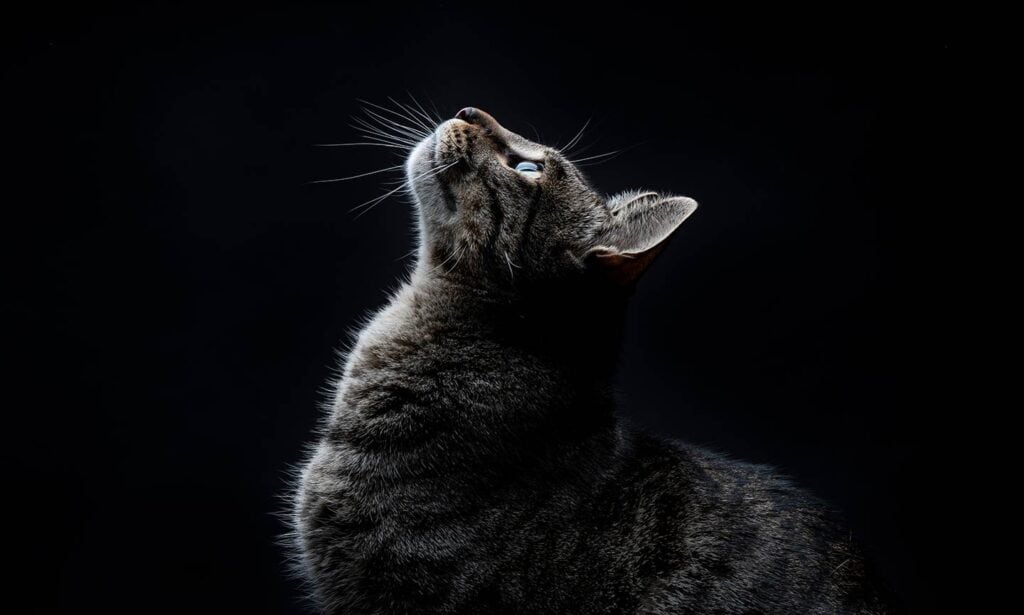
In the evening, my cat will occasionally turn her gaze upward and stare at something invisible to me. She will follow this entity with her eyes as it moves, apparently, along the wall just below the ceiling. She does not seem disturbed by what she perceives, just keenly interested. After a moment or two, she will blink and look away, settle back into my lap. Whether the object of her attention disappears or she simply grows bored with it, is anyone’s guess. “It’s their eyes,” a friend says. “They absorb light and then reflect it—like headlights on a road sign. Cats see a whole world we don’t.” I have no idea what my cat sees; I only know that sometimes, in my living room at night, we are not alone.

Recently I met a childhood grief counsellor. She works with preschoolers, children brought to her by over-cautious parents who do not understand that some boys and girls really do see ghosts, only they call them Grammy or Grandpa or Uncle Fred, whatever the case may be, and while the parents are alarmed by these sightings, the children are not. Too young to fear anything but falling or loud noises, they are typically comforted by their visions. Grammy has come to visit, this is all they know. Science has not yet entered their lives. Their world is made of magic, and magic allows for everything. As they get older and start to reason, they lose this perceptual power. By the age of seven it’s all but gone, along with those “imaginary friends” children often describe.

They remember past lives too, the counsellor went on, though only a few are highly verbal and can articulate these memories. One little boy, at two years old, recalled dying in a plane crash. He described the fiery plane and how he couldn’t get out of it, offering so many specifics that researchers were able to “solve” his case by tracing the details back to a pilot who did indeed crash in the ocean during the Battle of Iwo Jima.

What she has learned from children, the counsellor told me, makes her think twice about certain conditions–savant syndrome, child prodigies, even those phantoms the dying speak of. Science is a wonderful thing, she said, and sometimes it’s no help at all.

The Solace of Atheism

Religions deny the finality of death, promising eternal paradise or a punishing hellscape depending on the lives we led. A supreme deity decides our ultimate fate and often dispenses rewards and penalties during our lifetimes. In moments of worry or fear we can pray for mercy, allowing that our requests may be ignored—who are we to question the will of our maker?

In this respect we are no different from age-old cultures. What the ancients could not comprehend, they assigned to a god. Bounty or calamity, the gods took credit for it and man, awaiting his fate, cowered below.

We can now explain thunder and rainbows and the moon’s effect on our tides, but most people still adhere to the notion of an apocryphal godhead to whom they pray, even if these prayers go unanswered. Perhaps this behavior is ancestral: the desire to belong, to be in a club, to sit shoulder to shoulder with like-minded brethren. Maybe this sense of belonging is amplified, validated, in the new mega churches swollen with righteous believers. How could so many be wrong?

If the world’s religions were self-contained, there would be no problem. Unfortunately, religions bleed into one another. Throughout human history, religious differences and dissension have led to untold atrocities, and the hostility is not ebbing. The more adamant the believer, the more intolerance he cultivates. Warring faiths, with their stringent dogma and divisive rhetoric, will not teach us how to be good.

Atheism is defined as a lack of belief in gods. Atheism is not nihilism, nor denial, nor is it contentious. It is simply a way of living without belief in deities. One may wish to have faith in a god and still be an atheist.

As I find atheism such a peaceful ethos, I have a hard time fathoming its relative lack of popularity—the most recent survey reveals that 80% of Americans believe in God. Christianity encompasses the largest demographic, which is another surprising fact given its bewildering foundation: one god split three ways, the immaculate conception, a contradictory and often savage bible.  

Unable to accept the presence of a preeminent deity, I have no trouble seeing the holiness in everything from a tiny pebble to a blue whale. I am free to love whatever my eyes land on. The world is mine to worship.

When disasters occur, I don’t have to struggle with my faith; I don’t need to reconcile a beneficent god with a catastrophic hurricane, the suffering of children, birth defects or the Ebola virus.

And as for the fear of death, so what if there is no heaven or hell, no god pointing a damning finger? When the body fails and the brain goes offline, we lose consciousness. If we slip into nothingness, which seems the most likely scenario, what is there to fear?

Some cite “life after death” experiences as evidence of a divine dimension waiting for us. These accounts are not incompatible with secular views. Given the mind’s love of stories, flashbacks and images of loved ones strike me as perfectly reasonable. As the curtain closes, why wouldn’t the whole cast of characters be summoned? Why wouldn’t we see once more the people we loved the most?

Consciousness is the awareness of our existence. Being both subject and object, we cannot explain consciousness, we can only tune in or out of it. Many people near death have spoken of a mesmerizing white light which they are compelled to follow. Perhaps that tunnel of light is the trail of our consciousness, flaring one last wondrous time before darkness falls, in soft velvet folds, taking us back to the realm of pure possibility, where all that ever was begins and ends.