A Pithy Message


 Great news on the writing front! Minerva Rising Issue #5, containing my piece “Happy Hour,” is now in print. I’d love for you to read what I’ve been working on, and also to support this independent literary journal. Minerva Rising’s motto is “Celebrating the creativity and wisdom in every woman.” To purchase a subscription or buy individual issues, please click on this link. Thank you for your support of women writers.
Here’s a preview of “Happy Hour”
Roni picks up her vodka tonic, takes a long swallow, wipes her mouth with the back of her hand.
“I wasn’t sure what it was at first,” she says, setting down her glass. “I thought it might be a turtle. But then it swam up close and stopped, maybe ten feet from me, and I saw it was a river otter. I smiled. I thought it wanted to play. ‘Hello there,’ I said, or something like that, and it growled.”
She shakes her head. “Yeah, that scared me. The otter went under then—I could see the water swirling towards me. I started backpedaling. The next thing I knew, it was biting the hell out of my legs.”
“Oh my god,” I breathe, “that must have been horrible. What did you do?”
“Screamed. Kicked. I tried to push it away—that’s how this happened.” Roni holds up her left hand; half her little finger is gone. I had been wondering about that.
“I got bit about a dozen times.” She pulls up her pant leg to show me, and I notice she has stopped shaving her legs. Sure enough her calf is riddled with scars: punctures and a couple dark crescents. “There’s one on my thigh that took fourteen stitches.”
I peer at her leg, look back up. It’s been a long time since I’ve seen Roni, and studying her today is a pleasure I wasn’t prepared for. Like most women who are good-looking in their youth, she has grown more striking, as if now that her beauty is fully formed, she has taken possession of it. I would recognize that face anywhere, though much about her has changed. Her skin is very tanned for one thing, not those orangey tans you bake or spray on, but a weathered tan that shows the white laugh lines around her eyes. Her dark hair, which she used to wear in a long smooth braid, is now short and choppy. She is bigger, too, filled out with muscle; her arms are spectacular in that lime green tank top. What surprises me most is her smile—there’s an upper tooth missing on the side of her mouth; I can’t stop focusing on it. How long has she let that go?
“Jesus, Roni. How did you get away?”
“Someone in a boat heard me and zoomed over. They smacked the water with a paddle till the otter swam off. I had to get rabies shots.”
“Ewww. In your stomach?”
“No, they don’t do it that way anymore. Still hurts though. They give you shots in your hip when you come in, and then you get five more in your arm over the next month.”
“So they knew the otter was rabid?”
“No. You can’t tell if an animal is rabid unless you test its brain tissue.” She frowns. “I don’t think it was rabid, I think it was just protecting its young.” She lifts her drink and takes another swallow. “Otters have their pups wherever they can find cover—piles of driftwood, old beaver dens, log jams. I’d been fishing near the shoreline, near this huge fallen tree. I got hot, so I dropped anchor and went for a swim.” She flashes a grin, and the gap in her teeth comes back into view. “Wrong time, wrong place.”
Congratulations to the 2014 Lambda Literary finalists and winners!
Here’s a brief but moving montage of some of the authors talking about books that changed their lives.
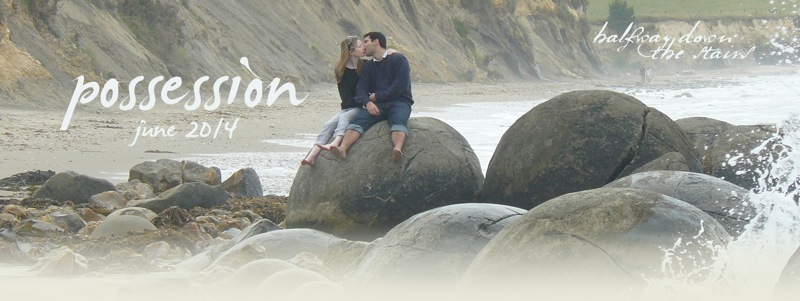
I am grateful to Alison Stedman, senior fiction editor, for including my story “The Golden Age” in the summer issue of Halfway Down the Stairs. This issue focuses on the subject of possession:
“Our possessions, the things we choose to own, are signifiers of our selves, external reflections that remind us of who we are, or want to be. We pick objects to represent us, to be our wordless emissaries. We display certain possessions to impress others, or to tell our story for us. Our stuff becomes a shorthand, a way to share who we are with an audience without revealing our history or hearts.” – Roxanna Bennett
Physicists tell us that thoughts, like everything else in the universe, are a form of energy. The more we dwell on something, the more energy we give it, and this energy spills out of us and into the world.
Yesterday I happened to see a deer and two fawns munching my agapanthus buds. I kept very still behind the window, and they did not know they were being watched. Eventually they moved off, carefully, gracefully, looking this way and that, before trotting across the street and disappearing into whatever hidden pockets they came from. It’s a miracle they are managing to find places to give birth, considering all the space we have taken from them. I regard my agapanthus flowers as an apology: the deer can have all they want.
It’s the effort that breaks my heart, the way animals make solid use of what’s left. At the nursery where I work, two house sparrows have made a nest in a privet topiary. From the birds’ point of view, the advantage of that dense green ball—excellent coverage—outweighs the disadvantage—foot traffic. Each time a customer traipses by, the mother, alarmed and fierce at once, flies out of the privet and onto a nearby roof from where she gives a series of warning chirps. This may not have been the best option available to the sparrows; then again, it may have involved more consideration than we think. Maybe our cooperation was something the birds factored in. Not only do we give that privet a wide berth, we have put a Sold sign on it which will stay in place until the young fly away. (We’ve also had to sequester more than a few hanging asparagus ferns—a plant to keep in mind if you’re interested in helping house sparrows.)
And then there are the baby katydids I find each year on the leaves of my lilac bush. There is just a handful of them, and they don’t eat much, certainly no more than they need, and before I have time to adequately admire their miniature beauty, they are gone.
In my collection SURVIVAL SKILLS, I explore the ways in which humans and the natural world intersect. If thought is a form of subtle energy, maybe animals, with their heightened senses, can tune into it. Maybe the deer I watch from my living room can feel my unceasing praise, and maybe this admiration strengthens them, the way love profits everything.

As a Lambda Literary finalist for my story collection SURVIVAL SKILLS, I am participating in a video compilation. These shorts will be presented as an opening video at this year’s Lambda Literary Awards in NYC on June 2, 2014. “A Book Saved My Life” is the subject, and my choice as an LGBT author is Kate Millett’s powerful and intimate autobiography, SITA.
I am grateful to Jennifer Hartsock for posting this interview on the Ashland Creek Press blog. Please visit the ACP website to learn more about this extraordinary publisher.
Ashland Creek Press is a small, independent publisher of books with a world view. Our mission is to publish a range of books that foster an appreciation for worlds outside our own, for nature and the animal kingdom, and for the ways in which we all connect.
 As many writers know, most editors disallow previously published submissions, including personal blog entries. There doesn’t seem to be much sense in this, given that the majority of bloggers have a modest number of followers, and the internet is not rife with their work. As for those canny bloggers with several thousand fans, well they are probably less interested in placing their work in a journal.
Once or twice a week, largely by chance, I discover a blogger whose writing moves me. I often leave comments on their blogs; occasionally I’ll use their contact forms to share my thanks or praise.
As an author, I craft my posts with care, knowing they represent my writing ability. I also try to choose topics I find compelling and important; I want my words to matter. From what I’ve seen, many other bloggers feel the same way. Their excellent posts deserve a wider readership.
Of course the dilemma of previously published material can be bypassed. Writers can forego their blogs and submit their best work to publishers instead. This approach is sound but frustrating. For one thing, most writers wait months for responses to their submissions, which makes for a lot of blog downtime. Bloggers, just to keep their site alive, are compelled to post other things in the interim, usually pieces in which they have less stake. Also, the content of some submissions is time-sensitive; a long wait can dilute their impact. In either case, the posts an author is most proud of, has worked hardest on, are not available.
I think it’s fair to require that posts submitted to journals be first removed from blogs, but refusing to consider any blog entry, however brief its appearance, seems excessive.
What do you think?
 As one of the contributors, I am delighted to announce the official launch of AMONG ANIMALS, a new collection of stories published by Ashland Creek Press.
“This diverse collection of stories explores the ways in which we live among—and often in conflict with—our non-human counterparts. These stories feature animals from the familiar (dogs and cats) to the exotic (elands and emus), and in these stories animals are both the rescuers and the rescued. Within these pages are glimpses of the world through the eyes of a zookeeper, a shelter worker, a penguin researcher, and a neighborhood stray, among many others—all highlighting the ways in which animals and humans understand and challenge one another.”
This compelling new book is available in paperback or digital form and is available for purchase now.
This piece in The Atlantic contains some of the best writing advice I’ve found, all in one handy place. Enjoy the wisdom of some of our greatest literary talents in How To Write.

 Jean Ryan