A Pithy Message


 Great news on the writing front! Minerva Rising Issue #5, containing my piece “Happy Hour,” is now in print. I’d love for you to read what I’ve been working on, and also to support this independent literary journal. Minerva Rising’s motto is “Celebrating the creativity and wisdom in every woman.” To purchase a subscription or buy individual issues, please click on this link. Thank you for your support of women writers.
Here’s a preview of “Happy Hour”
Roni picks up her vodka tonic, takes a long swallow, wipes her mouth with the back of her hand.
“I wasn’t sure what it was at first,” she says, setting down her glass. “I thought it might be a turtle. But then it swam up close and stopped, maybe ten feet from me, and I saw it was a river otter. I smiled. I thought it wanted to play. ‘Hello there,’ I said, or something like that, and it growled.”
She shakes her head. “Yeah, that scared me. The otter went under then—I could see the water swirling towards me. I started backpedaling. The next thing I knew, it was biting the hell out of my legs.”
“Oh my god,” I breathe, “that must have been horrible. What did you do?”
“Screamed. Kicked. I tried to push it away—that’s how this happened.” Roni holds up her left hand; half her little finger is gone. I had been wondering about that.
“I got bit about a dozen times.” She pulls up her pant leg to show me, and I notice she has stopped shaving her legs. Sure enough her calf is riddled with scars: punctures and a couple dark crescents. “There’s one on my thigh that took fourteen stitches.”
I peer at her leg, look back up. It’s been a long time since I’ve seen Roni, and studying her today is a pleasure I wasn’t prepared for. Like most women who are good-looking in their youth, she has grown more striking, as if now that her beauty is fully formed, she has taken possession of it. I would recognize that face anywhere, though much about her has changed. Her skin is very tanned for one thing, not those orangey tans you bake or spray on, but a weathered tan that shows the white laugh lines around her eyes. Her dark hair, which she used to wear in a long smooth braid, is now short and choppy. She is bigger, too, filled out with muscle; her arms are spectacular in that lime green tank top. What surprises me most is her smile—there’s an upper tooth missing on the side of her mouth; I can’t stop focusing on it. How long has she let that go?
“Jesus, Roni. How did you get away?”
“Someone in a boat heard me and zoomed over. They smacked the water with a paddle till the otter swam off. I had to get rabies shots.”
“Ewww. In your stomach?”
“No, they don’t do it that way anymore. Still hurts though. They give you shots in your hip when you come in, and then you get five more in your arm over the next month.”
“So they knew the otter was rabid?”
“No. You can’t tell if an animal is rabid unless you test its brain tissue.” She frowns. “I don’t think it was rabid, I think it was just protecting its young.” She lifts her drink and takes another swallow. “Otters have their pups wherever they can find cover—piles of driftwood, old beaver dens, log jams. I’d been fishing near the shoreline, near this huge fallen tree. I got hot, so I dropped anchor and went for a swim.” She flashes a grin, and the gap in her teeth comes back into view. “Wrong time, wrong place.”
Congratulations to the 2014 Lambda Literary finalists and winners!
Here’s a brief but moving montage of some of the authors talking about books that changed their lives.
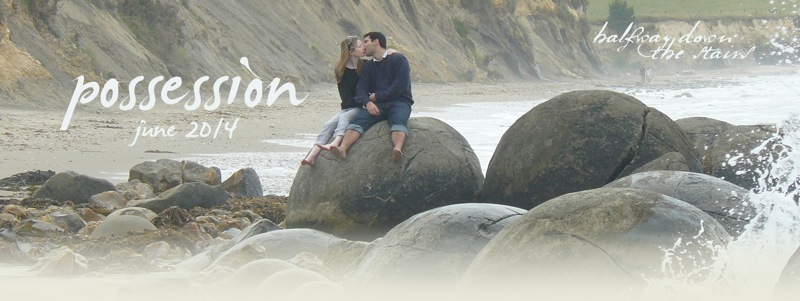
I am grateful to Alison Stedman, senior fiction editor, for including my story “The Golden Age” in the summer issue of Halfway Down the Stairs. This issue focuses on the subject of possession:
“Our possessions, the things we choose to own, are signifiers of our selves, external reflections that remind us of who we are, or want to be. We pick objects to represent us, to be our wordless emissaries. We display certain possessions to impress others, or to tell our story for us. Our stuff becomes a shorthand, a way to share who we are with an audience without revealing our history or hearts.” – Roxanna Bennett
Physicists tell us that thoughts, like everything else in the universe, are a form of energy. The more we dwell on something, the more energy we give it, and this energy spills out of us and into the world.
Yesterday I happened to see a deer and two fawns munching my agapanthus buds. I kept very still behind the window, and they did not know they were being watched. Eventually they moved off, carefully, gracefully, looking this way and that, before trotting across the street and disappearing into whatever hidden pockets they came from. It’s a miracle they are managing to find places to give birth, considering all the space we have taken from them. I regard my agapanthus flowers as an apology: the deer can have all they want.
It’s the effort that breaks my heart, the way animals make solid use of what’s left. At the nursery where I work, two house sparrows have made a nest in a privet topiary. From the birds’ point of view, the advantage of that dense green ball—excellent coverage—outweighs the disadvantage—foot traffic. Each time a customer traipses by, the mother, alarmed and fierce at once, flies out of the privet and onto a nearby roof from where she gives a series of warning chirps. This may not have been the best option available to the sparrows; then again, it may have involved more consideration than we think. Maybe our cooperation was something the birds factored in. Not only do we give that privet a wide berth, we have put a Sold sign on it which will stay in place until the young fly away. (We’ve also had to sequester more than a few hanging asparagus ferns—a plant to keep in mind if you’re interested in helping house sparrows.)
And then there are the baby katydids I find each year on the leaves of my lilac bush. There is just a handful of them, and they don’t eat much, certainly no more than they need, and before I have time to adequately admire their miniature beauty, they are gone.
In my collection SURVIVAL SKILLS, I explore the ways in which humans and the natural world intersect. If thought is a form of subtle energy, maybe animals, with their heightened senses, can tune into it. Maybe the deer I watch from my living room can feel my unceasing praise, and maybe this admiration strengthens them, the way love profits everything.

“How long does it flower?” I hear this question over and over, especially in the springtime when many plants are in glorious bloom. “A few weeks,” I reply, and the customers lose interest immediately. “Is that all?” they say.
“But look at the foliage,” I tell them, rushing to the plant’s defense. I point to a peony’s lovely-shaped leaves. “This plants stays lush and green until mid-fall.”
“Then what?”
“Then it goes into dormancy.”
“It dies?”
“No, it turns brown, but it comes back very early each spring.”
The customers shake their heads. “Oh no. I need something that stays green all year.”
“Well, you could plant azaleas or rhododendrons, or camellias.”
“Do they flower?”
“Absolutely.”
“How long?”
Basically, people are looking for eternal youth: a plant that stays beautiful forever. Mother Nature knocks herself out to give us breathtaking blooms, and we are not happy. Will we ever be? Will we ever look at the world, at ourselves, and see the hidden value?
Even more miraculous is a plant’s ability to come back from dormancy, to flower year after year. This is what our green world offers us: a fresh chance each spring to put things in perspective and be thankful for what is. What a gift.

A thought-provoking review by JoeAnn Hart, author of FLOAT.
As a Lambda Literary finalist for my story collection SURVIVAL SKILLS, I am participating in a video compilation. These shorts will be presented as an opening video at this year’s Lambda Literary Awards in NYC on June 2, 2014. “A Book Saved My Life” is the subject, and my choice as an LGBT author is Kate Millett’s powerful and intimate autobiography, SITA.
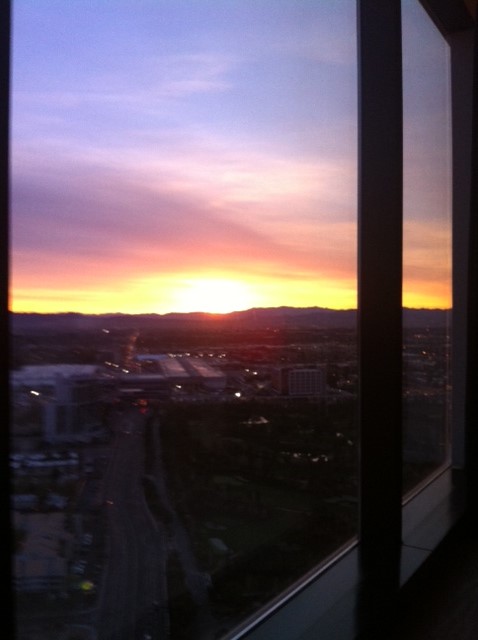
 This morning from the 39th floor of a Las Vegas hotel room I watched the sun rise over the mountains. Impervious to the sweeping humanity below them, these mountains are the area’s only static feature and serve as a boundary to the manic development. Without their silent enforcement, who knows how big Las Vegas could get? No way will this city stop itself.
You don’t spend much time in your room, luxurious though it is. You spend lots of time walking through the hotel. This is because the exits are few and far between; if it weren’t for fire safety, there probably wouldn’t be any. Reaching one of these secret outlets requires a winding trek past Baccarat and Black Jack tables; past acres of glowing slot machines; past Chanel, Cartier, Hermes, Gucci, Rolex; past sleek bars and stylish restaurants; past dazzling chandeliers, color-changing waterfalls, giant silk flowers, colossal glass balloons, massive mosaics. Stunned by the cumulative effect of these displays, you wander for hours, lost in time, for there are no clocks in these hotels and no windows. Light and temperature, meticulously controlled, are designed to make your body forget itself.
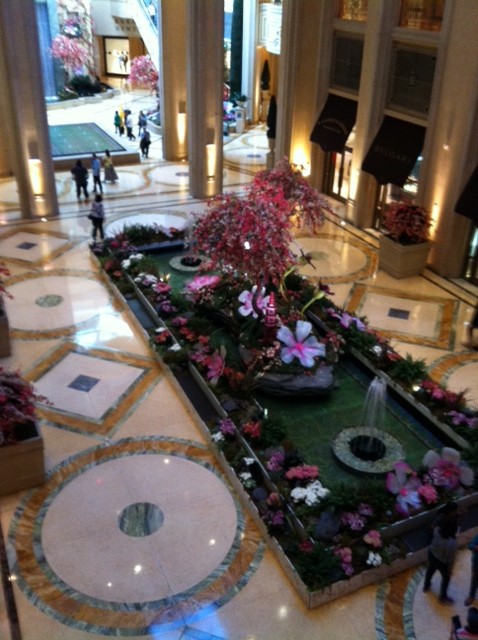 In an effort to keep guests inside at all costs, many hotels have joined forces and created connecting passageways. These escalators and skywalks are so effortless, so discreet, that you usually unaware of the transition. How did you get from the Encore to the Venetian, from the Palazzo to Caesar’s Palace? At last, exhausted by the journey, the visual stimulation, the constant campaign of music, you stumble into a lounge or restaurant and blearily eye the menu. By then you are inured to the exorbitant prices and scarcely bother to look at them.
What did you expect? This is, after all, Las Vegas. If you think a hotel that charges $370 a night should not charge another $20 for WiFi, you have a point, but so what? Money reigns supreme here. To suggest it has a limit amounts to blasphemy. If you cannot get into the spirit of spending, you need to leave the premises. Nothing personal—you just don’t belong.
I had not been to this city in fifteen years. Previously, I recall being charmed by the clever use of faux materials. This time the sets were alarmingly real. As I walked across miles of Italian marble, I began to understand the extent of the riches involved and it made me queasy.
Many people loathe Las Vegas. It is a reckless, heedless city. It stands for all the wrong things. One day this city will run out of water—the one thing it does not have a surfeit of—and nature will be the big winner.
The mountains are out there waiting.

 Jean Ryan