A Walk in the Park

My thanks to the editors at Digital Papercut for publishing my work. In “A Walk in the Park” a woman with some devastating secrets finds herself in a perilous spot.

My thanks to the editors at Digital Papercut for publishing my work. In “A Walk in the Park” a woman with some devastating secrets finds herself in a perilous spot.
Change is tricky. You don’t see it coming or going. You only know that at some point you put away your bread machine, stopped wearing your purple jacket, started listening to talk radio instead of CDs.
I just finished writing a short story using a method that surprised me. Typically I write in a linear fashion, letting the story roll out like a rug. How can you go wrong if you begin at the beginning and end at the ending? This latest tale spun out differently. I wrote the ending first and pieced the rest together like a quilt, working with the scenes that interested me, setting aside those that didn’t.
Both methods are difficult–all writing is difficult–but this new quilt-making approach roused my interest. It was like finding a secret passage or getting away with a clever crime. Could I really do this? What if the story had no momentum? What if the stitches were visible? Well, several people have read this story and I’m happy to say, so far so good.
I’ve heard that it is not uncommon for novelists to build their stories in this piecemeal fashion. I suppose the breadth of a novel, the long effort it requires, leaves more room for fancy. The brevity of the short form is a discipline, compelling writers of this genre to see the point and get to it. Discovering that I can work and juggle at the same time has put a measure of fun back into the job. I can hardly wait for the next surprise.
Dorothy Parker said, “I hate writing, I love having written.” What if you could love them both?

Minerva Rising is a literary journal “celebrating the creativity and wisdom in every woman.” My post, “The Art of Writing” was just published on their blog.
Please visit this inspiring site, especially geared to women who write.
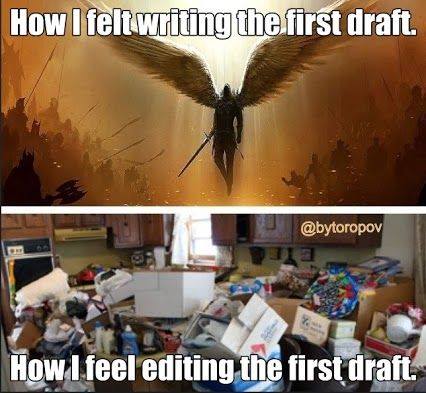
A friend posted this on my FB page the other day and it made me smile, mostly because my writing experience is the precise opposite. The creative stage is a long stumble through dark woods; the editing phase is a lakeside stroll on a summer day.
As I commit words to the page, I am hounded by my inner critic every inch of the way. She doesn’t believe in drafts and will not tolerate any sign of weakness, insisting that each line be strong enough to bear the weight of the next.
Not until all the sentences are mortared into place does my critic depart, apparently trusting me with the minor edits. I love it when she leaves.
What about you? Which writing stage do you most enjoy?
I am grateful to Alison Stedman, senior fiction editor, for including my story “The Golden Age” in the summer issue of Halfway Down the Stairs. This issue focuses on the subject of possession:
“Our possessions, the things we choose to own, are signifiers of our selves, external reflections that remind us of who we are, or want to be. We pick objects to represent us, to be our wordless emissaries. We display certain possessions to impress others, or to tell our story for us. Our stuff becomes a shorthand, a way to share who we are with an audience without revealing our history or hearts.” – Roxanna Bennett
Physicists tell us that thoughts, like everything else in the universe, are a form of energy. The more we dwell on something, the more energy we give it, and this energy spills out of us and into the world.
Yesterday I happened to see a deer and two fawns munching my agapanthus buds. I kept very still behind the window, and they did not know they were being watched. Eventually they moved off, carefully, gracefully, looking this way and that, before trotting across the street and disappearing into whatever hidden pockets they came from. It’s a miracle they are managing to find places to give birth, considering all the space we have taken from them. I regard my agapanthus flowers as an apology: the deer can have all they want.
It’s the effort that breaks my heart, the way animals make solid use of what’s left. At the nursery where I work, two house sparrows have made a nest in a privet topiary. From the birds’ point of view, the advantage of that dense green ball—excellent coverage—outweighs the disadvantage—foot traffic. Each time a customer traipses by, the mother, alarmed and fierce at once, flies out of the privet and onto a nearby roof from where she gives a series of warning chirps. This may not have been the best option available to the sparrows; then again, it may have involved more consideration than we think. Maybe our cooperation was something the birds factored in. Not only do we give that privet a wide berth, we have put a Sold sign on it which will stay in place until the young fly away. (We’ve also had to sequester more than a few hanging asparagus ferns—a plant to keep in mind if you’re interested in helping house sparrows.)
And then there are the baby katydids I find each year on the leaves of my lilac bush. There is just a handful of them, and they don’t eat much, certainly no more than they need, and before I have time to adequately admire their miniature beauty, they are gone.
In my collection SURVIVAL SKILLS, I explore the ways in which humans and the natural world intersect. If thought is a form of subtle energy, maybe animals, with their heightened senses, can tune into it. Maybe the deer I watch from my living room can feel my unceasing praise, and maybe this admiration strengthens them, the way love profits everything.

As a Lambda Literary finalist for my story collection SURVIVAL SKILLS, I am participating in a video compilation. These shorts will be presented as an opening video at this year’s Lambda Literary Awards in NYC on June 2, 2014. “A Book Saved My Life” is the subject, and my choice as an LGBT author is Kate Millett’s powerful and intimate autobiography, SITA.
I am grateful to Jennifer Hartsock for posting this interview on the Ashland Creek Press blog. Please visit the ACP website to learn more about this extraordinary publisher.
Ashland Creek Press is a small, independent publisher of books with a world view. Our mission is to publish a range of books that foster an appreciation for worlds outside our own, for nature and the animal kingdom, and for the ways in which we all connect.
 As many writers know, most editors disallow previously published submissions, including personal blog entries. There doesn’t seem to be much sense in this, given that the majority of bloggers have a modest number of followers, and the internet is not rife with their work. As for those canny bloggers with several thousand fans, well they are probably less interested in placing their work in a journal.
Once or twice a week, largely by chance, I discover a blogger whose writing moves me. I often leave comments on their blogs; occasionally I’ll use their contact forms to share my thanks or praise.
As an author, I craft my posts with care, knowing they represent my writing ability. I also try to choose topics I find compelling and important; I want my words to matter. From what I’ve seen, many other bloggers feel the same way. Their excellent posts deserve a wider readership.
Of course the dilemma of previously published material can be bypassed. Writers can forego their blogs and submit their best work to publishers instead. This approach is sound but frustrating. For one thing, most writers wait months for responses to their submissions, which makes for a lot of blog downtime. Bloggers, just to keep their site alive, are compelled to post other things in the interim, usually pieces in which they have less stake. Also, the content of some submissions is time-sensitive; a long wait can dilute their impact. In either case, the posts an author is most proud of, has worked hardest on, are not available.
I think it’s fair to require that posts submitted to journals be first removed from blogs, but refusing to consider any blog entry, however brief its appearance, seems excessive.
What do you think?

 Jean Ryan