Among Animals

amonganimals_250As one of the contributors, I am delighted to announce the official launch of AMONG ANIMALS, a new collection of stories published by Ashland Creek Press.
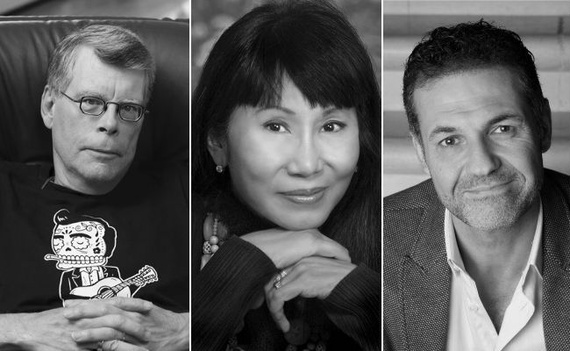
“This diverse collection of stories explores the ways in which we live among—and often in conflict with—our non-human counterparts. These stories feature animals from the familiar (dogs and cats) to the exotic (elands and emus), and in these stories animals are both the rescuers and the rescued. Within these pages are glimpses of the world through the eyes of a zookeeper, a shelter worker, a penguin researcher, and a neighborhood stray, among many others—all highlighting the ways in which animals and humans understand and challenge one another.”

This compelling new book is available in paperback or digital form and is available for purchase now.


A Few Of My Favorite Books

This is a guest post I wrote for Carla Sarett’s inspiring blog:  carlasarett.blogspot.com

This list includes some of my all-time favorite books.

There is another book I’d like to mention, one that is especially appropriate as a gift from mothers to daughters. Veterans Day reminded me of this illuminating and fascinating read.

Our Mothers’ War: American Women at Home and at the Front During World War II by Emily Yellin

To Alice Munro

Recently a friend commented on a story from my collection. She told me how much she despised one of the characters (an attractive, unscrupulous woman), and then she proposed alternate outcomes for her. Had I considered doing this with her instead of that? Was I going to write another story about her? Maybe next time she could be overweight, deep in debt—in trouble with the feds! In other words: What Happens Next?

I am often surprised by how invested people can be in the stories they read, how unwilling they are to let go of them. When I told my friend that I had no plans to continue this story line, that when I was done with a story, I was done with it, her face fell. “Maybe you will,” she said, “later.” I smiled and said, “You never know.”

Rousing this degree of interest is of course a good thing, indicating that I did my job as a writer. Still, I wish she had said something about the style of the story. Was it a smooth read? Did she have any favorite passages or images? Had I chosen the best point of view? Did she notice the alliteration? Was the dialogue convincing? Was the setting real?

As I writer I notice all these things when I read. I can tell right away if an author has labored hard, or if he has taken short cuts. If the sentences aren’t clean, if the images aren’t striking, if the writing does not make me pause, think and admire, I probably won’t be finishing the book. Life is short. I want to read the sort of stories that make me wish I had written them, like the carefully crafted work of Alice Munro.

Readers are travelers; books are vehicles. Unless they are writers themselves, most readers don’t seem to care much about how the vehicle works, the machinery behind the journey. Imperfections, even outright errors, are forgiven, if they are noticed at all, so long as pace is maintained. While they may enjoy the passing scenery, what readers want most is to get where they’re going. If the destination pleases them, they will want to go back, hang out with the same characters, see what new trouble they can get into, learn what happens next.

The Da Vinci Code. Harry Potter. The Girl with the Dragon Tattoo. Fifty Shades of Grey. These are wildly popular rides, and I respect the authors. A gift to the masses is no small thing.

Blockbusters like these are what makes the latest literary news such a nice surprise. It was Alice Munro who just received the Nobel Prize, and not for crowd-pleasing novels, but for her unstinting effort in the improbable short story genre. Cheers to you, Alice, for giving the world your very best again and again, for writing against the grain and from the heart. That’s showing them.

alice-munro

The Tipping Point

images

At what point do you take your writing seriously? When do you start believing you’re a writer?

Certainly passion is a criterion. You can’t be much of a writer without an irrepressible urge to put ideas into words. You may resist this urge, resenting the time it takes you away from other activities, other people, but eventually it wins, and you find yourself once again opening your toolbox of words in hopes of revealing what is obscured. These words will never be precise enough, will always fall short of perfection, but you can’t be dissuaded from trying.  In your desire to find meaning, in your focus on the page, you will miss out on many wondrous things. You know this. You write anyway.

But passion isn’t all, is it? There must be something else: a growing suspicion, a fear almost, that what you’re creating has merit. I don’t know precisely when this happened for me, only that it did.

I don’t think it has much to with publishing credits, or the occasional encouraging comment from an editor. That’s like being told you’re pretty—a nice thing to hear, but unless you believe it yourself, you remain unconvinced. You can write a bestseller and still feel like a fake. The tipping point must be different for every writer. Some never find it, while others acknowledge their gift early on.

I was dubious of my talent for a very long time, discouraged by the genius and productivity of so many superior authors. Eventually it dawned on me that these writers were not my competition but my comrades, and I could acknowledge their excellence and still proceed with my own work. I didn’t have to be a prodigy, didn’t have to produce a book a year or win the Nobel prize, I just had recognize my own skills so that I could start measuring up to…myself. Once I saw what I might do, my efforts gained momentum.

What do I think of my work? Enough to make it better.

Betting on Books

Next month is the long-awaited launch of my short story collection, SURVIVAL SKILLS. Soon I’ll be joining the ranks of all the other authors who are hoping their newly published books will find an audience.

In the past several months, many of us have been doing what we can to get the word out, mostly through social media: Facebook, Twitter, Goodreads, Pinterest. How successful these marketing venues have been for us remains to be seen. All we know is that exposure is key, and the more we like and follow, tweet and retweet, post and share, the greater our chances for recognition. For those of us who were not brought up in the electronic age, learning the tricks involved in setting up blogs and author pages is challenging to say the least, and it doesn’t help that technology is constantly jumping ahead of itself. Writers of any age would rather be writing than cyber networking, but we enter the fray and do our best.

The most daunting reality I’ve experienced thus far is the sheer number of us. Racing toward the same goal, we are teammates competing with each other. After all, there is only so much recognition to go around, only so much money to spend on books. It’s a selling frenzy and a buyer’s market, with books selling for less than a dollar, or being given away, by the thousands, in hopes of actual sales. Publishers in this country, electronic and otherwise, churn out 800 books a day. In this galaxy of productivity, what sort of odds does one book, my book, have?

And where do buyers begin? With self-publishing having eclipsed conventional forms, how do readers determine quality? Can we trust bloggers and reviewers? Stars and likes? Considering the many ways a web presence can be manipulated, does 15,000 Twitter followers mean anything at all? The internet is a monstrous game of chance and everyone is placing bets.

I’ve no idea how one separates the wheat from the chaff. And of course, one man’s chaff is another man’s wheat. I have zero interest in vampire novels, however well written, but who can dispute their  popularity? I like literary short fiction, a genre not known for blockbuster sales (which is ironic when you consider our tight schedules and short attention spans). I’ve asked people about this and they tell me that short stories don’t deliver, that they just don’t have enough meat on the bone. Well, I think there are plenty of meaty stories out there, stories that amuse and amaze, stories that will break your heart. You just need to know where to look.

So what can I say about SURVIVAL SKILLS? What bare truths can I give you? I can tell you that this an honest offering, that these stories evolved over several years and required my best effort. I can tell you that most of them originally appeared in reputable journals. I can tell you that my publisher, Ashland Creek Press, is committed to promoting quality literature that explores our connections with the natural world.

The characters in SURVIVAL SKILLS are not heroes. Like you and me, they are just trying to outlast the perils that surround them, taking what comfort they can on the way and often acquiring some strange companions. You won’t come across any vampires in these tales, but I’m betting you’ll enjoy them anyway.

http://www.ashlandcreekpress.com/books/survivalskills.html

Survival Skills Cover

The Next Best Thing Project

As part of The Next Best Thing Project, I am answering some interview questions concerning my collection, SURVIVAL SKILLS, which will be published by Ashland Creek Press in April 2013. Many thanks to JoeAnn Hart for tagging me for this exciting venture.

http://joeannhart.com/

I am tagging these other authors so that we can continue to connect with one another and discover new works.

Jennifer Simpson, Director of DimeStories International  http://akajesais.com

Dyane Forde, fantasy writer   http://goo.gl/8VkTz


What is the title of your book? 

SURVIVAL SKILLS

Where did the idea come from for the book?

Most of the stories were inspired by something I had read or a show I had seen. “Migration” issued from the real story of a Toulouse goose that lived in a park in Los Angeles and became smitten with one of the visitors. “Looks for Life” also came from real events—a co-worker told me about a friend of his whose life changed after a plastic surgeon rebuilt his face. “Waiting for Annie” followed a special I had seen on coma, the “silent epidemic.” Improved emergency response techniques and sophisticated life support machines are keeping more and more lives in this eerie state of suspension. Especially intriguing to me is the mind’s ability to make connections by itself, to persist without the complement of consciousness. “Paradise” emerged from a program I had watched about intelligence in birds, parrots in particular. One bird had acquired a prodigious vocabulary and this stirred my imagination. I thought it would be fun to work this creature into a story, to use him in fact as a main character. In order to create conflict, the parrot in this tale is malicious as well as brilliant. The extravagance of Palm Springs, its artificial overlay, seemed an apt parallel to the various indulgences that Max enjoyed in his man-made abode.

What genre does your book fall under?

Literary short fiction. I love the short story form, how quickly the reader is pulled in. Poised between poems and novels, short fiction aims for precision and intrigue. I think the quality of writing in literary short fiction is often superior to the writing in novels. Novels can become weighted down with exposition. Short pieces must get to the point quickly. This urgency requires distillation, which is a challenge I revel in.

Which actors would you choose to play your characters in a movie rendition?

As SURVIVAL SKILLS is a story collection, this is a tricky question to answer.  But if I had to cast one story, it might be “The Side Bar,” for which I would choose Helen Hunt as the narrator, Jeff Daniels as Ronny, Kristen Wiig as Carla and Cate Blanchett as Louise.

What is the one-sentence synopsis of your book?

“Ryan writes of beauty and aging, of love won and lost—with characters enveloped in the mysteries of the natural world and the animal kingdom.”

How long did it take you to write the first draft of your manuscript?

These stories were written over a period of several years. As they began to gel into a collection, I was able to understand what interests me most as a writer: the natural world and the vulnerability and interdependency of all living things. I enjoy exploring the connections, the synchronicities, the quiet miracles underlying the world we see. Fear and the relative fragility of the human mind fascinate me in particular.

 What other book might you compare to SURVIVAL SKILLS within this genre?

While there are many excellent contemporary collections—Jean Thompson and Antonya Nelson are brilliant short story writers—the closest match to the nature content and unusual relationships in SURVIVAL SKILLS might be BIRDS OF A LESSER PARADISE by Megan Mayhew Bergman.

Who or What inspired you to write this book?

I am endlessly inspired by natural phenomena and the many ways people find to survive their difficulties.

What else about your book might pique the reader’s interest?

I hope readers will enjoy what they might learn about the natural world; I certainly had fun doing the research. I also hope that the humor will make them smile along the way. I think people are reassured by humor; it makes them feel better.