The Writer’s High

I have finished writing another short story. The world is not waiting for this story, I do not anticipate payment (certainly nothing commensurate with the effort), and readership will likely be modest, assuming I find a publisher. Still, I am elated.

Why? If not for payment or acclaim, why do we write? What sustains us? What accounts for the gratification?

It is not hope. When we are fully engaged in our writing, what time is there for hope? What use is hope?

Nor is it pride. While we may be pleased with our stamina and resolve, we know that our talent will always fall short of our vision, and we accept this. We write anyway.

Spiritual leaders teach us that pleasure dependent on nothing is the only pleasure that lasts. I think our writerly thrill comes from this mysterious, inviolable place, beyond the reach of fame and fortune and everything else that comes and goes. This is the answer to our effort, this very private bliss. For as long as we live, for as long as we write, we have access to it.

I once attended an excellent reading by a famous author. Afterward, someone in the audience asked this woman if she had a blog. The author said no, explaining that she had made a promise to herself to never write anything for free. You have to admire that kind of integrity, but I wonder: How can she resist?

Writing Outside the Lines

Change is tricky. You don’t see it coming or going. You only know that at some point you put away your bread machine, stopped wearing your purple jacket, started listening to talk radio instead of CDs.

I just finished writing a short story using a method that surprised me. Typically I write in a linear fashion, letting the story roll out like a rug. How can you go wrong if you begin at the beginning and end at the ending? This latest tale spun out differently. I wrote the ending first and pieced the rest together like a quilt, working with the scenes that interested me, setting aside those that didn’t.

Both methods are difficult–all writing is difficult–but this new quilt-making approach roused my interest. It was like finding a secret passage or getting away with a clever crime. Could I really do this? What if the story had no momentum? What if the stitches were visible? Well, several people have read this story and I’m happy to say, so far so good.

I’ve heard that it is not uncommon for novelists to build their stories in this piecemeal fashion. I suppose the breadth of a novel, the long effort it requires, leaves more room for fancy. The brevity of the short form is a discipline, compelling writers of this genre to see the point and get to it. Discovering that I can work and juggle at the same time has put a measure of fun back into the job. I can hardly wait for the next surprise.

Dorothy Parker said, “I hate writing, I love having written.” What if you could love them both?

Coloring-outside-the-lines-225x300

Creating and Editing

10532383_858901434137179_2828328367610926227_n


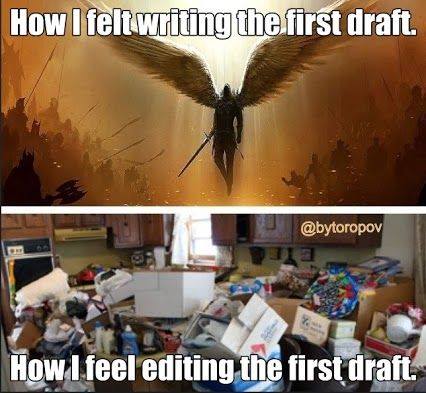
A friend posted this on my FB page the other day and it made me smile, mostly because my writing experience is the precise opposite. The creative stage is a long stumble through dark woods; the editing phase is a lakeside stroll on a summer day.

As I commit words to the page, I am hounded by my inner critic every inch of the way. She doesn’t believe in drafts and will not tolerate any sign of weakness, insisting that each line be strong enough to bear the weight of the next.

Not until all the sentences are mortared into place does my critic depart, apparently trusting me with the minor edits. I love it when she leaves.

What about you? Which writing stage do you most enjoy?


“Happy Hour” in Minerva Rising

header_20140213Great news on the writing front! Minerva Rising Issue #5, containing my piece “Happy Hour,” is now in print. I’d love for you to read what I’ve been working on, and also to support this independent literary journal. Minerva Rising’s motto is “Celebrating the creativity and wisdom in every woman.” To purchase a subscription or buy individual issues, please click on this link.  Thank you for your support of women writers.

Here’s a preview of “Happy Hour”

Roni picks up her vodka tonic, takes a long swallow, wipes her mouth with the back of her hand.

“I wasn’t sure what it was at first,” she says, setting down her glass. “I thought it might be a turtle. But then it swam up close and stopped, maybe ten feet from me, and I saw it was a river otter. I smiled. I thought it wanted to play. ‘Hello there,’ I said, or something like that, and it growled.”

She shakes her head. “Yeah, that scared me. The otter went under then—I could see the water swirling towards me. I started backpedaling. The next thing I knew, it was biting the hell out of my legs.”

“Oh my god,” I breathe, “that must have been horrible. What did you do?”

“Screamed. Kicked. I tried to push it away—that’s how this happened.” Roni holds up her left hand; half her little finger is gone. I had been wondering about that.

“I got bit about a dozen times.” She pulls up her pant leg to show me, and I notice she has stopped shaving her legs. Sure enough her calf is riddled with scars: punctures and a couple dark crescents. “There’s one on my thigh that took fourteen stitches.”

I peer at her leg, look back up. It’s been a long time since I’ve seen Roni, and studying her today is a pleasure I wasn’t prepared for. Like most women who are good-looking in their youth, she has grown more striking, as if now that her beauty is fully formed, she has taken possession of it. I would recognize that face anywhere, though much about her has changed. Her skin is very tanned for one thing, not those orangey tans you bake or spray on, but a weathered tan that shows the white laugh lines around her eyes. Her dark hair, which she used to wear in a long smooth braid, is now short and choppy. She is bigger, too, filled out with muscle; her arms are spectacular in that lime green tank top. What surprises me most is her smile—there’s an upper tooth missing on the side of her mouth; I can’t stop focusing on it. How long has she let that go?

“Jesus, Roni. How did you get away?”

“Someone in a boat heard me and zoomed over. They smacked the water with a paddle till the otter swam off. I had to get rabies shots.”

“Ewww. In your stomach?”

“No, they don’t do it that way anymore. Still hurts though. They give you shots in your hip when you come in, and then you get five more in your arm over the next month.”

“So they knew the otter was rabid?”

“No. You can’t tell if an animal is rabid unless you test its brain tissue.” She frowns. “I don’t think it was rabid, I think it was just protecting its young.” She lifts her drink and takes another swallow. “Otters have their pups wherever they can find cover—piles of driftwood, old beaver dens, log jams. I’d been fishing near the shoreline, near this huge fallen tree. I got hot, so I dropped anchor and went for a swim.” She flashes a grin, and the gap in her teeth comes back into view. “Wrong time, wrong place.”


The Golden Age

I am grateful to Alison Stedman, senior fiction editor, for including my story “The Golden Age” in the summer issue of Halfway Down the Stairs. This issue  focuses on the subject of possession:

“Our possessions, the things we choose to own, are signifiers of our selves, external reflections that remind us of who we are, or want to be. We pick objects to represent us, to be our wordless emissaries. We display certain possessions to impress others, or to tell our story for us. Our stuff becomes a shorthand, a way to share who we are with an audience without revealing our history or hearts.”  –  Roxanna Bennett

header28


Q&A with Jennifer Hartsock

I am grateful to Jennifer Hartsock for posting this interview on the Ashland Creek Press blog. Please visit the ACP website to learn more about this extraordinary publisher.

cropped-ashlandheader5

Ashland Creek Press is a small, independent publisher of books with a world view. Our mission is to publish a range of books that foster an appreciation for worlds outside our own, for nature and the animal kingdom, and for the ways in which we all connect.